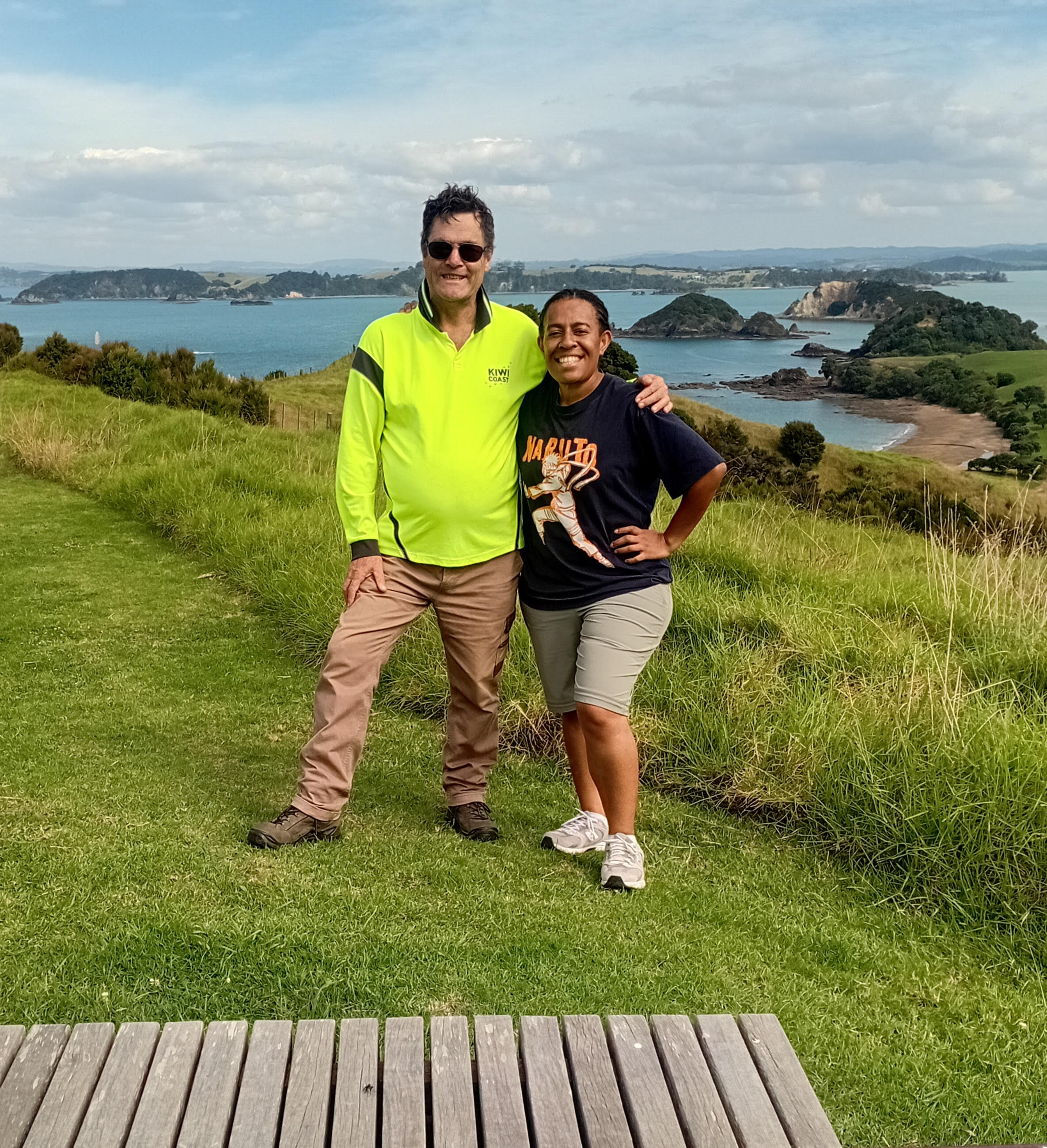
Azalea Anota, a master’s student from Massey University, recently visited the Purerua-Mataroa Peninsula in the Bay of Islands as part of her research on kiwi health and disease. During her visit, she was guided around the peninsula by Andrew Mentor from Kiwi Coast and Tiwai Rawiri from Pest Free Pēwharangi, who shared insights into both the cultural history of the area and the conservation work taking place.
The visit included time at Rangihoua Heritage Park, a site of deep significance to Ngāti Torehina ki Matakā and to the wider history of Aotearoa, with Rangihoua being the location where Samuel Marsden delivered the first Christian sermon in New Zealand in 1814.
In recent years, the Purerua Peninsula has become a stronghold for kiwi conservation through an extensive predator control project, managed by Kiwi Coast with strong support from community groups, local hapu and the regional council.
Azalea’s research on the peninsula focuses on Toxoplasma gondii, a microscopic parasite that causes the disease toxoplasmosis, or toxo for short. Cats are the primary hosts of the parasite and shed it through their faeces where it lives in soil and water. Kiwi can become infected when exposed to contaminated environments, and toxoplasmosis has been linked to illness and mortality in some birds, as well as marine mammals after the parasite spread through waterways, and found its way into dolphins.
By comparing sites with predator hosts present and sites where predator control is underway, Azalea’s research aims to better understand how the parasite may be transmitted in kiwi habitats and marine environments.
Azalea expressed her gratitude to the local iwi and community for sharing their knowledge and connection to the land, and to the conservation teams working tirelessly to protect kiwi across the Purerua-Mataroa Peninsula.


